Workflow & Deliverables
Processed in ESA’s Sentinel-1 Toolbox (SNAP) from RADARSAT-2 quad-pol SAR data (RS2-SLC-FQ9-ASC-09-Apr-2008) following standard polarimetric procedures [1].
| Deliverable | Purpose & Output |
|---|---|
| Freeman–Durden .KMZ | Terrain-corrected three-component decomposition (surface, double-bounce, volume scattering) draped in Google Earth Online [2]. |
| Pauli vs. Yamaguchi | Side-by-side SNAP comparison of coherent Pauli RGB and four-component Yamaguchi RGB decompositions over San Francisco [1]. |
Press Space or Right Arrow to reveal deliverables & advance
Freeman–Durden .KMZ Export in Google Earth Online
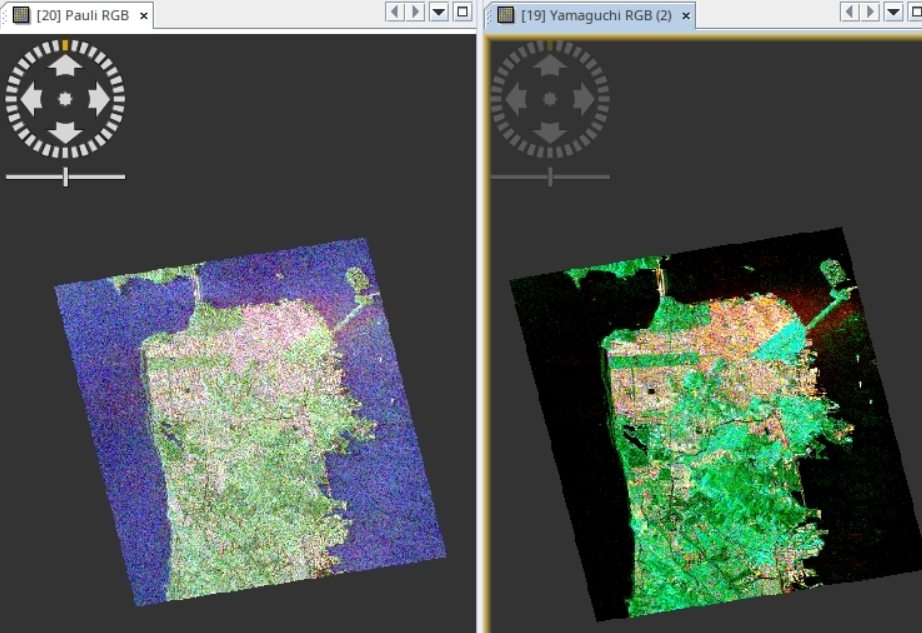
San Francisco Overlay [2]
Terrain-corrected Freeman–Durden decomposition exported from SNAP as .kmz and viewed in Google Earth Online.
Product (click highlighted tokens to inspect):
Down arrow for scattering-channel breakdown · Click image to enlarge
Freeman–Durden Scattering Interpretation
Visual mapping observed in the draped Google Earth Online layer ([4] Freeman-Durden RGB) [2]:
Blue — Surface Scattering
Dominates smooth open water across the Pacific Ocean and San Francisco Bay.
Green — Volume Scattering
Highlights Golden Gate Park, the Presidio, and vegetated coastal hills south toward Daly City and Pacifica.
Red / Magenta — Double-Bounce
Concentrated along dense urban street grids, building facades, and port/bridge infrastructure.
Georeferencing Check
Terrain correction (TC) aligns coastlines, Golden Gate Bridge, Bay Bridge, and I-280 directly onto the optical basemap.
Up arrow to return to main slide · Right arrow for Slide 4
Side-by-Side Pauli and Yamaguchi Decompositions
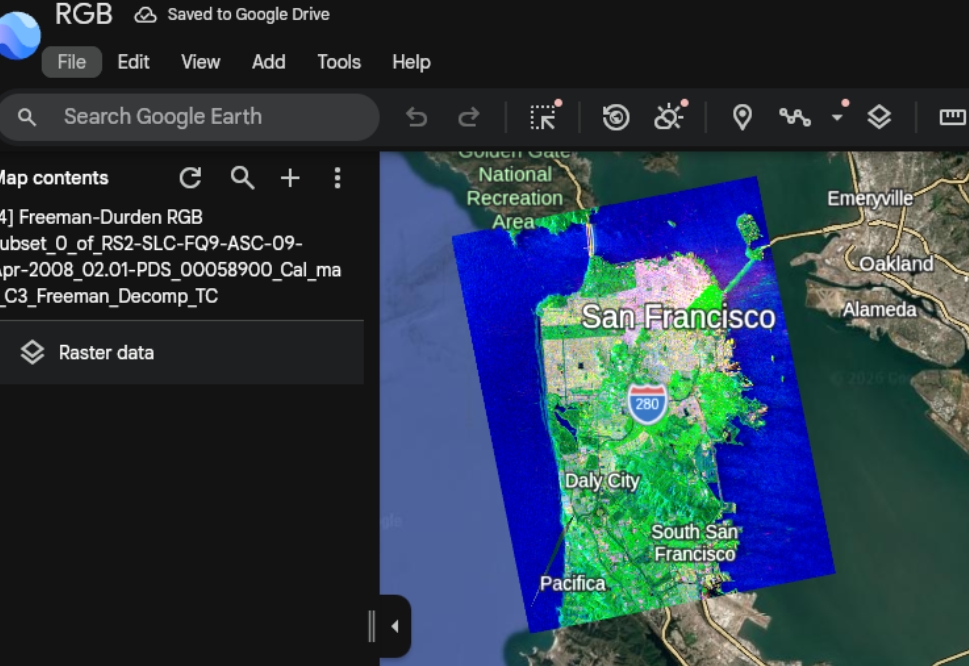
SNAP Comparison (San Francisco) [1]: Coherent Pauli RGB decomposition alongside four-component Yamaguchi RGB decomposition for the RADARSAT-2 FQ9 ascending scene.
Click image to enlarge · Down arrow for visual contrast summary
Pauli vs. Yamaguchi: Visual Contrast in SNAP [1]
Left — [20] Pauli RGB
Coherent decomposition operating on the complex scattering matrix S. Preserves fine structural detail and exhibits stronger speckle/blue surface return over the surrounding ocean and bay.
Right — [19] Yamaguchi RGB (2)
Model-based four-component incoherent decomposition (surface, double-bounce, volume, helix). Suppresses open-water clutter and sharpens street-grid orientation and Golden Gate Park boundaries.
Up arrow to return to main slide · Right arrow for References
References
-
Braun, Andreas and Venci, Luis (2020). Polarimetry with Radarsat-2. ESA, Sentinel-1 Toolbox Tutorial, Science Toolbox Exploitation Platform (STEP). Accessed: 2026-11-23.
-
Ackermann, Stefan Georg (2026). Freeman–Durden Decomposition KMZ Overlay in Google Earth Online. Created November 23, 2026.